
W produkcjiAsset do Unity
Segmentis
Segmentis is a node-based worldbuilding tool for Unity. Build destructible buildings, shape terrain, grow forests, and turn the same world into a flat map or a 2.5D strategy landscape.
ProtoSegmentis 2018 Official thesis (otwiera się w nowej karcie)
O projekcie
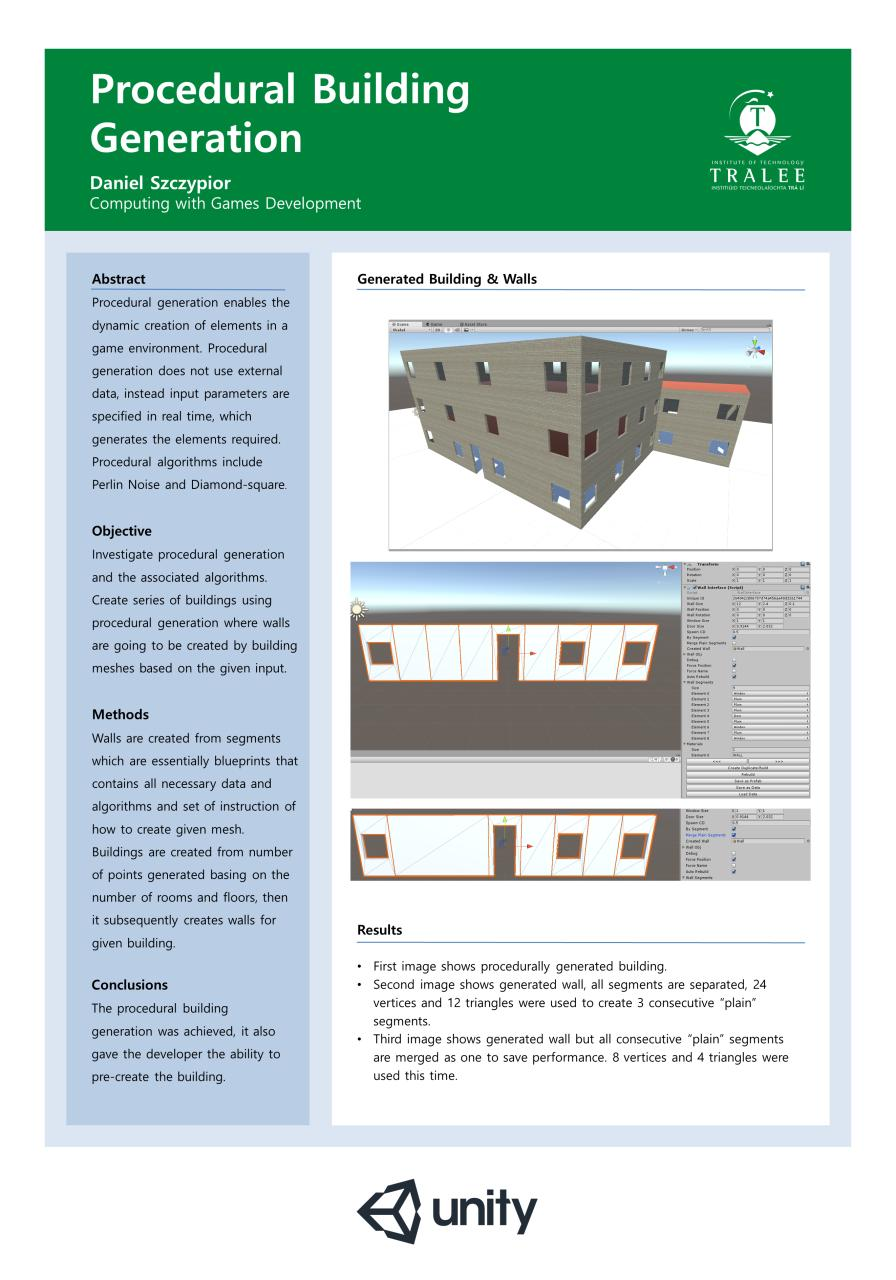
Segmentis started in 2018 as my university thesis for my diploma, it was done as a tool for unity to enable procedural building generation during runtime and in editor. It got rewritten 2 times during the proto stage alone. By the end of the project it was a working system albeit not without its caveats. It was fully limited to buildings, at runtime could generate only by code, and had problems with roofs. It was truly a prototype, but it teached me enough to be able to know what is wrong and what to fix in the next rewrite.
I then for 3 years worked on its successor, Segmentis 1.0, a full rewrite. It became a good system, blueprint based, each blueprint could contain other blueprint and reference them. Its design principle is simple, to make buildings you make rooms, to make rooms you make walls, to make walls you make wall segments, this makes it far easier to actually achieve anything and control the entire system. Unfortunately that system had limitations, it could design buildings, allow dragging of the walls to expand them, design entire houses, proper roof systems, stairs, foundation, painting of walls. All that thought could stay building only as it would be fighting with the system to create anything else, basically inventing new stuff and just duck taping it together.
By 2021 I knew the system was not what I originally envisioned, the system was stopped and then rewritten into Segmentis 2.0.
Unlike the standard system it does not use a unity graph system. Instead I made my own, this enabled the system to work both runtime and in editor. It merely needs 2 scripts attached to game objects and players during level design can use node graphs themself. The system takes any prefab or any code by reflection, it offers a simple vertex design mode where you draw points on a graph and then tell how to connect it. You can paint anything, every system has destruction capability. Maps can be created by mesh or unity terrain.
Możliwości
-
Buildings by drawing
In the Building Tool you click out rooms, walls, floors, stairs, roofs, doors and windows straight in the scene view. Move a corner and the walls, floors and roof follow. Walls can be curved, and room shapes don't have to sit on a grid. Every room is guaranteed a way in. -
Paint
You can paint wall panels, wall sides, whole rooms, floor tiles and roof faces. All the paint uses one shared material (one atlas, one shader), which keeps draw calls low. -
More than buildings
The same graph also makes terrain, whole generated worlds with biomes, rivers and lakes, plus trees, rocks and scattered plants. Everything is seeded, so results are repeatable. -
Destruction built in
Walls, floors, roofs and stairs break into pieces and take damage, and buildings can collapse when their supports are destroyed. Doors open and shut. -
One node graph does everything
A scene object stores only its graph. The meshes are rebuilt from the graph when the scene loads and after every edit, so scenes stay small and nothing goes stale.
Więcej możliwości
- Procedural Building Generation100% procedural, driven by an in-house system.
- Runtimer Mesh generationThe mesh, along with its vertices, normals, and associated attributes, is generated algorithmically.
- Editable at any levelYou can click any generated part to tweak it right there, or open the Graph Editor and change the nodes behind it. Undo works for both.
- Scales upCopies save only what changed, distance levels reduce detail far away, and templates let you start new objects in one click.
Jak powstaje
wpisy w devlogu: 2 · od 2026
Używany w
W produkcjiGra
Project emperor